Partner with REAL Impact Group to help parents and schools strengthen student outcomes.
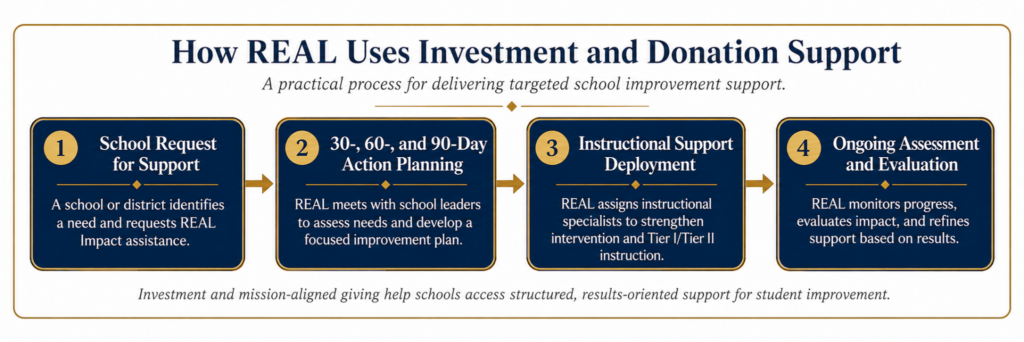
Partner with REAL Impact Group to help schools strengthen student outcomes.
Support REAL Impact Group through giving to help parents and priority schools strengthen student outcomes.
What are Priority Schools?
Priority schools are public K–12 schools that have been identified for additional support because student achievement, school performance, or accountability indicators show a need for improvement. In Alabama, priority schools may include schools designated by the State Superintendent of Education or schools that received a D or F on the most recent state report card, excluding schools that exclusively serve special populations.
Many priority schools face urgent academic challenges, including low reading proficiency, weak literacy and math recovery, achievement gaps, and chronic absenteeism. These schools and districts are often under significant pressure to show measurable progress before the next accountability cycle.
Why is support needed for priority schools?
Priority schools need targeted financial and instructional support so they can provide stronger interventions for students who are performing below grade level. These schools are not failing because educators are unwilling to work hard. In many cases, teachers, principals, and district leaders are already working intensely to improve student outcomes. However, they may need additional support, resources, coaching, data review, and implementation planning to move from effort to measurable progress.
Many high-need schools also face resource challenges. National school funding analyses have found that high-poverty districts often receive less state and local revenue than lower-poverty districts, even though students in high-need communities may require additional academic, social, and instructional support. The Education Trust reported that high-poverty districts receive, on average, 5% less state and local revenue than low-poverty districts, while the Education Law Center emphasizes that fair school funding should provide sufficient funding for all students and additional funding for high-poverty districts. For this reason, targeted investment can help priority schools strengthen instruction, align interventions, support teachers, and accelerate student growth.
Sources: The Education Trust, Equal Is Not Good Enough; Education Law Center, Making the Grade 2025.